

The frequency response of a pro mixer is a crucial factor that significantly influences audio quality. As a leading pro mixer supplier, we understand the intricacies of how frequency response works and its impact on the final audio output. In this blog, we will delve into the relationship between frequency response and audio quality in a pro mixer.
Understanding Frequency Response
Frequency response refers to the range of frequencies that a device can reproduce and the accuracy with which it can do so. In the context of a pro mixer, it determines how well the mixer can handle different audio frequencies, from the lowest bass notes to the highest treble tones. A mixer with a wide and flat frequency response can accurately reproduce all frequencies within its range, resulting in a more natural and balanced sound.
The frequency spectrum is typically divided into three main regions: low frequencies (bass), mid - frequencies, and high frequencies (treble). Each region plays a vital role in the overall audio quality.
- Low Frequencies (Bass): Frequencies below 200 Hz are generally considered low frequencies. These frequencies provide the foundation and warmth of the audio. A pro mixer with a good low - frequency response can accurately reproduce deep bass notes without distortion. For example, in a music track with a strong bassline, such as electronic dance music, a mixer that can handle low frequencies well will make the bass sound tight and punchy, rather than muddy or weak.
- Mid - Frequencies: The mid - frequency range, usually from 200 Hz to 2 kHz, contains most of the vocal and instrument details. A flat and accurate mid - frequency response is essential for clear and intelligible audio. If the mid - frequencies are not reproduced correctly, vocals may sound muffled, and instruments may lose their distinctiveness. For instance, in a live concert, a mixer with excellent mid - frequency handling will ensure that the singer's voice comes through clearly, and the guitars and keyboards have their unique timbres.
- High Frequencies (Treble): Frequencies above 2 kHz are the high frequencies. They add brightness, clarity, and presence to the audio. A pro mixer with a good high - frequency response can reproduce the delicate details of cymbals, hi - hats, and other high - pitched sounds. Without proper high - frequency reproduction, the audio may sound dull and lack sparkle.
Impact of Frequency Response on Audio Quality
Clarity and Intelligibility
One of the most significant impacts of frequency response on audio quality is clarity and intelligibility. When a pro mixer has an accurate frequency response across all ranges, the audio signals are reproduced as they were originally recorded or performed. This means that every instrument and vocal in a mix can be clearly heard and distinguished. For example, in a podcast, clear and intelligible speech is of utmost importance. A mixer with a well - balanced frequency response will ensure that the host's voice is crisp and easy to understand, without any unwanted coloration or distortion.
Balance and Tone
The frequency response also affects the balance and tone of the audio. A mixer with a flat frequency response allows the audio engineer to shape the sound according to their preferences. They can use the mixer's equalization (EQ) controls to boost or cut specific frequencies to achieve the desired balance between different elements in the mix. For instance, if a track has too much bass, the engineer can use the EQ to reduce the low frequencies and bring the overall sound into balance. On the other hand, if a mixer has a built - in frequency response that is not flat, it can introduce unwanted tonal imbalances that are difficult to correct.
Spatial Imaging
Frequency response plays a role in creating a sense of space and depth in the audio. Different frequencies are perceived differently in terms of their spatial location. High frequencies tend to be more directional, while low frequencies are more omnidirectional. A pro mixer that can accurately reproduce the frequency content of an audio signal will help create a more realistic and immersive listening experience. For example, in a surround sound system, a mixer with good frequency response will ensure that the audio is properly panned across different speakers, creating a sense of space around the listener.
Our Pro Mixers and Frequency Response
As a pro mixer supplier, we offer a range of mixers with exceptional frequency response characteristics. Our Pro Mixer models are designed to provide a wide and flat frequency response, ensuring accurate audio reproduction.
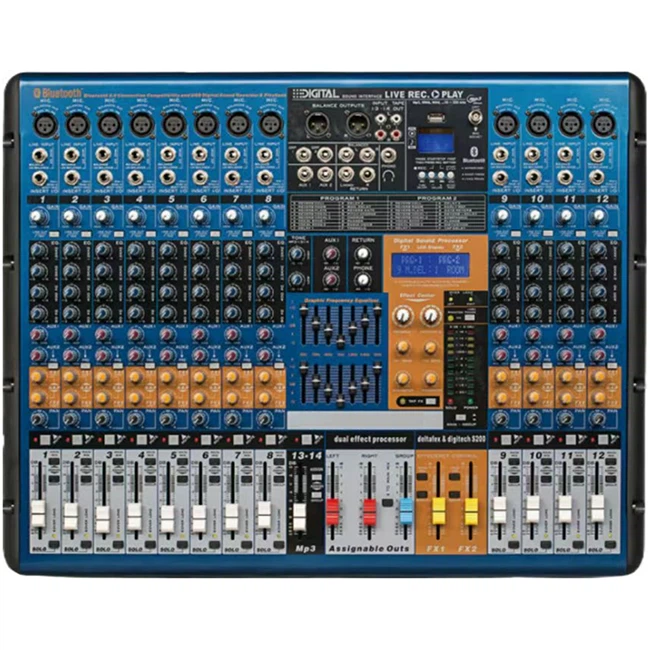
For smaller setups or applications where portability is a key factor, our 12 Channel Powered Mixer is an excellent choice. It has been carefully engineered to handle a wide range of frequencies with precision. The mixer's pre - amps and EQ sections are optimized to maintain a clean and accurate frequency response, allowing you to create high - quality audio mixes.
If you need a more powerful and feature - rich mixer for larger events or professional studios, our 20 Channel Mixer is the ideal solution. It offers a comprehensive set of controls for fine - tuning the frequency response of each channel. The mixer's advanced circuitry ensures that even at high gain settings, the frequency response remains flat and distortion - free, delivering outstanding audio quality.
Importance of Testing Frequency Response
Before purchasing a pro mixer, it is essential to test its frequency response. This can be done using various methods, such as using test tones and analyzing the output with a spectrum analyzer. By testing the frequency response, you can ensure that the mixer meets your specific audio quality requirements.
In our experience as a pro mixer supplier, we have found that customers who take the time to test the frequency response of our mixers are more satisfied with the final audio results. They are able to achieve a more professional and polished sound, whether they are working on music production, live sound reinforcement, or other audio applications.
Conclusion
In conclusion, the frequency response of a pro mixer has a profound impact on audio quality. It affects clarity, balance, tone, and spatial imaging, all of which are crucial for creating high - quality audio mixes. As a pro mixer supplier, we are committed to providing mixers with excellent frequency response characteristics. Our Pro Mixer, 12 Channel Powered Mixer, and 20 Channel Mixer are designed to meet the diverse needs of audio professionals.
If you are in the market for a pro mixer and want to discuss your specific requirements, we invite you to get in touch with us. Our team of experts is ready to assist you in finding the perfect mixer for your application and to ensure that you achieve the best possible audio quality.

References
- Everest, F. A., & Pohlmann, K. C. (2015). Master Handbook of Acoustics. McGraw - Hill Education.
- Toole, F. E. (2008). Sound Reproduction: The Acoustics and Psychoacoustics of Loudspeakers and Rooms. Focal Press.