

As a supplier of small wall speakers, I often get asked about the impulse response of these devices. Understanding the impulse response is crucial for anyone looking to purchase high - quality audio equipment, whether it's for a home theater system, a commercial venue, or a public address setup. In this blog post, I'll explain what impulse response is, why it matters for small wall speakers, and how it affects the overall audio quality.
What is Impulse Response?
Impulse response is a measurement of how a system responds to a very short, intense input signal, known as an impulse. In the context of audio, an impulse is a single, instantaneous burst of sound. When this impulse is sent through a speaker, the speaker's impulse response shows how it reproduces that sudden sound over time.
Mathematically, the impulse response of a linear time - invariant (LTI) system can be used to predict the system's output for any input signal. By convolving an input signal with the impulse response of a speaker, we can calculate how the speaker will transform the original signal.

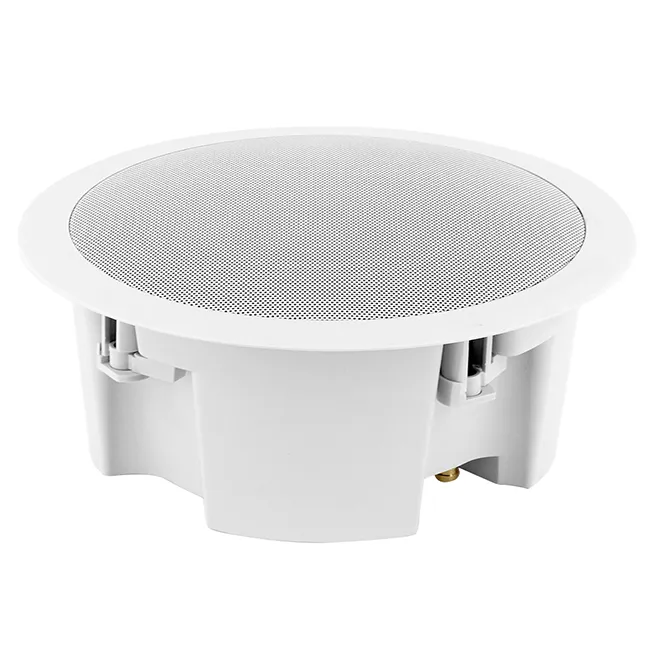
For small wall speakers, the impulse response provides valuable information about their transient response. Transient response refers to how quickly and accurately a speaker can reproduce sudden changes in the audio signal, such as the attack of a drum or the pluck of a guitar string. A speaker with a good impulse response will be able to reproduce these transients cleanly, without smearing or distortion.
Why Impulse Response Matters for Small Wall Speakers
Small wall speakers are often used in spaces where space is limited, such as apartments, offices, or small retail stores. In these environments, the ability to reproduce clear and accurate audio is essential. A poor impulse response can lead to several audio problems:
- Distortion: If a speaker has a slow or inaccurate impulse response, it may not be able to keep up with rapid changes in the audio signal. This can result in distortion, where the sound becomes muddled or harsh. For example, a drum hit may sound more like a dull thud instead of a sharp crack.
- Poor Imaging: Imaging refers to the ability of a speaker to create a precise soundstage, where different instruments and voices can be located in specific positions in the stereo field. A speaker with a good impulse response will be able to reproduce the spatial cues in the audio signal more accurately, resulting in better imaging. On the other hand, a speaker with a poor impulse response may cause the sound to seem unfocused or spread out.
- Reduced Clarity: Clear audio is essential for understanding speech and enjoying music. A speaker with a good impulse response will be able to reproduce the high - frequency details in the audio signal, such as the sibilance in a singer's voice or the sparkle of cymbals. A poor impulse response can cause these details to be lost, resulting in a less clear and engaging listening experience.
Factors Affecting the Impulse Response of Small Wall Speakers
Several factors can affect the impulse response of small wall speakers:
- Driver Design: The design of the speaker driver, including its size, shape, and materials, plays a significant role in determining the impulse response. Smaller drivers may have a faster transient response but may also have limitations in terms of low - frequency reproduction. On the other hand, larger drivers may be able to produce more bass but may be slower to respond to sudden changes in the audio signal.
- Enclosure Design: The enclosure in which the speaker driver is mounted also affects the impulse response. A well - designed enclosure can help to control the movement of the driver and reduce unwanted resonances. For example, a sealed enclosure can provide a tighter and more accurate bass response, while a ported enclosure can increase the low - frequency output at the expense of some transient accuracy.
- Crossover Design: In multi - driver speakers, the crossover network is responsible for dividing the audio signal into different frequency bands and sending them to the appropriate drivers. A poorly designed crossover can introduce phase shifts and other artifacts that can degrade the impulse response. A high - quality crossover will be able to split the signal cleanly and ensure that each driver receives the correct frequencies without introducing distortion.
Measuring the Impulse Response of Small Wall Speakers
There are several methods for measuring the impulse response of small wall speakers. One common method is to use a test signal generator and an audio analyzer. The test signal generator sends an impulse signal to the speaker, and the audio analyzer measures the output of the speaker over time. The resulting waveform is the impulse response of the speaker.
Another method is to use a software - based measurement system, such as Room EQ Wizard (REW). These systems can analyze the audio signal using a microphone placed in the listening position and calculate the impulse response of the speaker. This method is more convenient for in - home measurements and can provide valuable information about the speaker's performance in a real - world environment.
Comparing Small Wall Speakers Based on Impulse Response
When comparing different small wall speakers, it's important to look at the impulse response in addition to other specifications, such as frequency response and power handling. A speaker with a good impulse response will generally provide a more accurate and engaging listening experience.
Some manufacturers may provide impulse response data for their speakers, either in the product manual or on their website. If this information is not available, you can try to find independent reviews or measurements from audio enthusiasts or professional reviewers. You can also listen to the speakers in person and pay attention to the transient response and overall clarity of the sound.
Related Products
If you're interested in other types of speakers, we also offer a range of ceiling speakers, including the 5 Ceiling Speaker, Fireproof Ceiling Speaker, and Ceiling Speaker with Cover. These speakers are designed to provide high - quality audio in a variety of ceiling - mounted applications.
Conclusion
The impulse response of small wall speakers is an important factor to consider when purchasing audio equipment. A speaker with a good impulse response will be able to reproduce sudden changes in the audio signal accurately, resulting in clearer, more detailed, and more engaging sound. By understanding the factors that affect the impulse response and how to measure it, you can make a more informed decision when choosing small wall speakers for your home or business.
If you're interested in learning more about our small wall speakers or have any questions about impulse response, please don't hesitate to contact us for a procurement discussion. We're here to help you find the best audio solution for your needs.
References
- Toole, Floyd E. "Sound Reproduction: The Acoustics and Psychoacoustics of Loudspeakers and Rooms." Focal Press, 2019.
- Beranek, Leo L. "Acoustics." American Institute of Physics, 1986.